

Andrew Long Photography

End of year report 2025

It probably says more about my OCD tendencies than anything else, but I’ve spent an enjoyable (!) few days sorting through my film library and camera collection to compile the mother-of-all-spreadsheets: an end-of-year report for my photography habit. In fact it’s been more than a year, the period reviewed is from August 2024, when I first picked up a film camera since the early 1990s, to the end of December 2025, so that’s 17 months. I’ve lumped it all together for the purposes of the report, but if you really want to know, 77% of the films shot were in 2025.
It’s been a few years since I’ve played with Excel, but having spent several decades working with spreadsheets of different generations, it slowly came back to me. I was actually impressed at some of the formulas I remembered! Did take a while to de-bug the spreadsheet though, eventually getting it all to balance …
The headline figure is that over that period I shot (or have it still in the camera) 214 films, which is just over 12 films a month … yes, I’ve been prolific or snap-happy (delete as appropriate!). The vast majority have been developed at home in my darkroom. Of those, 72% were black & white, 27% colour, and just two colour slide films, both still to be developed.
Of the 214, 10 were failures (a 5% failure rate), either because of a faulty camera, a handling mistake on my part, or problematic development. This number includes some very out-of-date films that I should probably have just binned before wasting my time shooting and developing them - I know some people love shooting expired film, but it’s not for me.
The vast majority of the 214 (70%) were 35mm, but I shot 7 different formats over the period. 14% were shot with Minox ‘spy’ cameras, 7% 110, and 5% 16mm, the ‘lost’ film format of the 1960s. I don’t expect these proportions to change much for 2026 as I enjoy shooting them all and still have much to learn, but I expect the more traditional roll film formats (127, 120, and 620) to feature more.
To feed these more unusual formats, I load my own films, cutting or slitting down larger films into these smaller formats: 35mm to the 9.2mm used in Minox, and 16mm used in 16mm and 110; and 120 down to 16mm/110 and also down to 127. To make a 620, it’s just a case of re-spooling 120 onto the 620 spools. Minox and 16mm are easy to load, but 110 can be more tricky, especially if you try to cut open old OEM cassettes - they were never meant to be opened (labs just crack them to access the film), so it involves careful surgery with a craft knife, and lots of sticky tape! New cassette designs made by 3D printing from the likes of Ausgeknipst and Camerahack will hopefully make loading easier (and less dangerous!) this year.
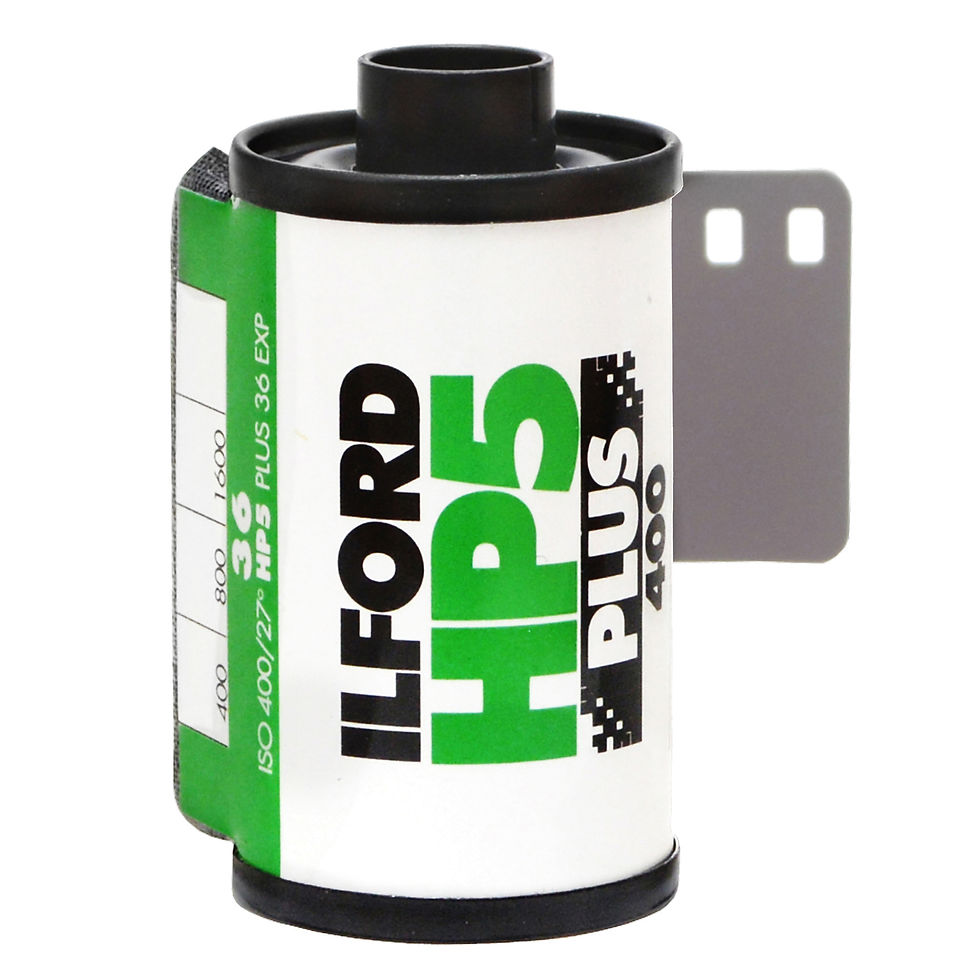
I used to work for Kodak back in the day, but this time round I am a dedicated Ilford and Harman fan, who’s products account for 58% of my usage (41% Ilford, and 18% Harman, the latter being mostly Kentmere). Kodak, in both B&W and colour, account for 17% of the total. The relatively high percentage for Adox (6%) reflects my use of Adox HR-50 as my go-to film for Minox photography. Lomography films at 7% are mostly 110 films, as they are the only company making new films in that format. I expect the Lomo figure to drop as I get to grips with self-loading 110.
I shot 36 different emulsions over the period, with the Ilford B&W classics HP5+ (14%) and FP4 (12%) taking up the lion’s share. As mentioned, Adox HR-50 is boosted by Minox use, and I don’t see that changing. Harman’s colour negative film, Phoenix (both I & II) is

artificially high (7%) because I was using it as my film for the Frugal Film Project throughout 2025 (FFP25)*. This won’t be continued in 2026 because I’m shifting to Kentmere 200 - my experience with Phoenix hasn’t been all positive, so I expect my remaining stocks of it will languish in my fridge for some time. The Kentmere family (100, 200, and 400) has featured strongly at 11%, and this will increase with FFP26. Delta 100 performed well at 7%, and I plan to use this more as a donor film for 16mm & 110. My biggest Kodak films were Gold 200 and Pro Image 100, both at 5%, although I’m shooting more Tri-X than I used to. And there is a ‘long tail’ of other film emulsions across different brands, formats, speeds, and types, as I experiment and learn my craft. I’m interested to see how Ilford XP2 Super 400 performs when slit down to Minox, 16mm, and 110. I’ll also be shooting more slide film (Ektachrome 64 and 100G) when the weather gets better, and will be slitting it down to the subminiature sizes - I have Minox and Minolta 16 slide projectors waiting to be tried, although getting the film into the tiny mounts will be a challenge!

In terms of cameras, well, my collection has … er … grown somewhat. I shot (or are currently shooting) 55 different cameras over the period! Nikon cameras accounted for 36% of the total, which isn’t bad considering I had never used a Nikon prior to acquiring a gorgeous 1977 Nikon F2A 35mm camera in September 2024. I now own 6 Nikon 35mm bodies, with a selection of manual focus lenses … 20% of all the films shot during this period were done with the F2A, and the F3 HP and FE both accounted for 7%.

The diminutive Minox 35 ML is a firm favourite of mine (7% of films shot over 2 cameras), and it was also my FFP25 camera. The clunky but enjoyable East German Praktica BMS Electronic also accounted for 7% (two bodies, with a selection of lenses). The best of the rest include the Pentax Auto 110 system at 4%, and, all at 3%, the Minox 35 GT, the Minox A and C ‘spy’ cameras, the compact Olympus OM-20, and the Minolta 7000, the only autofocus SLR I own.


A special mention for the Voigtländer VITO CLR 35mm rangefinder from 1960, a gorgeous 35mm rangefinder. I’ve acquired several more similar 1960s fixed lens rangefinder-type cameras, and look forward to getting film in them this year.


I love the compact Minox 35 ML & GT, which slip easily into a pocket - the lens is fantastic and both are so easy to shoot with, once you've got your head round zone focusing. I prefer the shutter speed LEDs of the ML to the needle of the GT, but it's a minor difference.
The similarly dimensioned Rollei B35 also has a fantastic lens, but is less intuitive (downright fiddly!) and has lots of sharp edges that snag on fabric. I’m looking forward to trying the diminutive Olympus XA2, just as soon as I get round to replacing the light seals.


My Minox subminiature range has … er … also grown a bit - the B was joined by an A (a.k.a. IIIs), a C, an LX, a BL (probably my favourite of the range - CdS meter but otherwise fully mechanical), and most recently an EC, which is the smallest cameraI possess. All produce 8x11mm negatives from the 9.2mm film strip. The lenses are great, and I love the challenge of seeing what can be achieved from that tiny neg. I’m also looking forward to giving my 16mm cameras, of which I have quite a few (Minolta, Mamiya, Kiev, Rollei), some more use in 2026, and I’ll be experimenting to find the ultimate subminiature emulsion. However, there is a small confession to make ... there are 42 more cameras on the shelves in various states of usability that will hopefully get some shutter time in the next 12 months!


In summary, I’ve had a fantastic year (OK, 17 months) learning the craft of film photography. I’ve learned so much about the science behind it all, the miracles of photo-chemistry, and the technology in these gorgeous vintage cameras. I’ve made many mistakes, but have learned from each one. I’ve enjoyed exploring my local surroundings and seeing landscapes (urban and rural), seascapes (I live by the coast), structures, and nature in, literally, a new light. I’ve also enjoyed being part of the vibrant international film photography community, fellow film and camera geeks who are quick to lend a hand, and slow to judge. I’ve made many good acquaintances, and also some good friends in the process. I’ve also enjoyed writing about my new hobby on my own website and in various blogs, and sharing my previous experience in product development with some very talented and enthusiastic people.
And I’m looking forward to doing more of the same in 2026.
I don’t normally bother with New Year Resolutions, but this year is an exception. I’ve had the means to print from negatives in my darkroom for months, but I haven’t built up the courage to try it. This year, and before my 60th birthday at the beginning of March, I will take the plunge and give it a go ….
* The Frugal Film Project is a very active Facebook group that celebrates the use of cheap (less than $75) cameras. Although film is not included in that budget, the general idea is that it is of the cheaper variety, too. Participants post their images throughout the year, month by month, and there is a lively but supportive chat around them. One aspect I particularly like is the international profile of the group, and you get to see all parts of the world captured on film with no political nonsense associated with the images - just good photography by fellow enthusiasts. For more information see https://www.facebook.com/groups/1163101494091862/


Yours has been an interesting journey to follow via facebook, Thank you for sharing